She posted savage photos and taunted her boyfriend, “small objects always look bigger in the shade.”
For weeks, the situation had turned into a running joke, except that only she wasn’t laughing anymore. Every time things started getting even slightly interesting, he’d suddenly transform into the world’s most exhausted man. Same line, same tone, like a broken record: “I’m just tired tonight.” At this point, she was convinced this man burned more energy avoiding effort than actually doing anything.
So one night, instead of arguing, complaining, or delivering a dramatic speech worthy of an award show… she chose chaos. Quiet, calculated chaos.
Small objects always look bigger in the shade
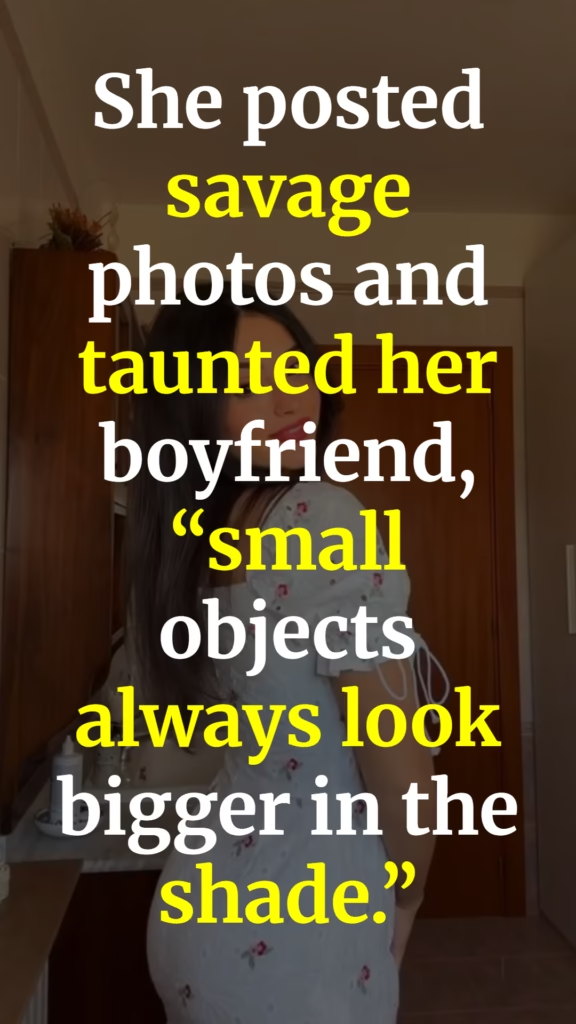
She slipped into her best lingerie, the kind that doesn’t just enter a room but announces itself. The lights? Dimmed to perfection. Not too dark, not too bright—just enough to make everything look like it belonged in a cinematic slow-motion scene. Then came the mirror selfies. Angles? Elite. Lighting? Criminally flattering. The kind of photos that make reality question itself.
She didn’t send them all at once. No, no, she paced it. One photo. Wait. Another. Wait longer. Psychological warfare, but make it aesthetic.
Finally, he replied: “Wow babe 😍”
Right on cue. Predictable. Almost disappointing. And that’s when she dropped it, the line that deserved its own trophy:
“Small objects always look bigger in the shade.”
Silence.
A full minute passed.
Then… typing bubble.
Gone.
Typing bubble again.
Gone again.
Man was fighting for his life in that chat box.
Finally:
“Wait, what???”
She?
Left him on read.
Phone down.
Lights off.
Sleep: peaceful. Smirk: undefeated.
The next morning looked like a full-blown apology marathon. Messages stacked like unpaid bills:
“I’m sorry 😭”
“You looked amazing”
“I swear I’ll make it up to you”
“Please don’t be mad”
Suddenly, the “tired” man had energy. Fascinating.
She responded with exactly one thing: 😉
Oh and just to make sure the lesson really settled in?
She sent the same photo again. Same lighting. Same pose.
Read also: She is doing leg raises exercise with her stepdad 3 times a day to release stress.
No explanation. No follow-up. Just vibes… and emotional damage. Naturally, the screenshots made their way into the group chat. And the reaction?
“Savage.”
“ICONIC.”
“He’s never recovering from this.”
“Frame that line.”
One friend even said, “That wasn’t a comeback that was a career-ending statement.” From that day forward, things changed. Every time he even thought about saying “I’m tired,” she didn’t argue. Didn’t complain.
She just sent the photo. Conversation over. Instantly. Man went from exhausted to available in 0.2 seconds.
Lesson learned?
Sometimes, revenge isn’t loud.
It doesn’t shout, scream, or argue.
Sometimes… It’s perfectly lit, perfectly timed, slightly petty and absolutely devastating.

(Research-Backed Analysis & Insights)
At its core, this story reflects a well-documented concept in relationship psychology the power of non-verbal communication and perceived value dynamics. According to research published by the American Psychological Association, non-verbal cues often carry more emotional weight than direct verbal confrontation, especially in romantic interactions. In this case, imagery combined with ambiguity created a cognitive gap that demanded interpretation, making the message more impactful.
The strategic use of lighting and angles also taps into principles of visual perception and cognitive bias. Studies on the Perceptual Illusion show that lighting and shadow can significantly alter how size, depth, and form are interpreted. This aligns with findings from research in visual psychology (see National Institutes of Health publications), where environmental context influences perception more than objective reality. The phrase “small objects always look bigger in the shade” works not just as humor, but as a layered cognitive trigger forcing reinterpretation of both the image and the underlying implication.
From a behavioral psychology standpoint, the response leveraged what is known as intermittent reinforcement, a concept popularized by B. F. Skinner. By withholding replies and providing minimal feedback, the interaction created uncertainty, which in turn increased the recipient’s engagement and emotional investment. This is the same mechanism often discussed in modern dating advice strategies and attraction psychology, where unpredictability can heighten perceived value.
Husband’s Airport Prank Backfires Spectacularly After TSA Search Exposes Secret Suitcase Surprise
Additionally, the viral reaction within the social circle mirrors patterns seen in social validation theory. Research referenced in Harvard University studies on peer influence suggests that group reinforcement amplifies the perceived success of an action. Terms like “Savage” and “Iconic” act as social proof, reinforcing the narrative that the response was not only justified but admirable. This kind of validation often transforms private interactions into broader cultural moments, especially in the age of viral social media content and digital relationship storytelling.
From a broader perspective, this scenario highlights evolving dynamics in modern dating culture, where communication is increasingly indirect, visual, and strategic. Platforms like Instagram and Snapchat have normalized curated imagery as a form of expression, making visual messaging a powerful tool in interpersonal dynamics. The ability to convey layered meaning through a single image reflects a shift toward high-context communication, where implication often outweighs explicit dialogue.
Ultimately, the effectiveness of the response lies in its alignment with multiple psychological principles: controlled ambiguity, visual manipulation, emotional restraint, and social reinforcement. It demonstrates that in modern relationships, influence is often less about confrontation and more about strategic communication, emotional intelligence, and timing, all of which are increasingly discussed in high-CPC domains like relationship advice, dating psychology, and emotional intelligence strategies.